3D Scanning and Reverse Engineering in the Marine Industry
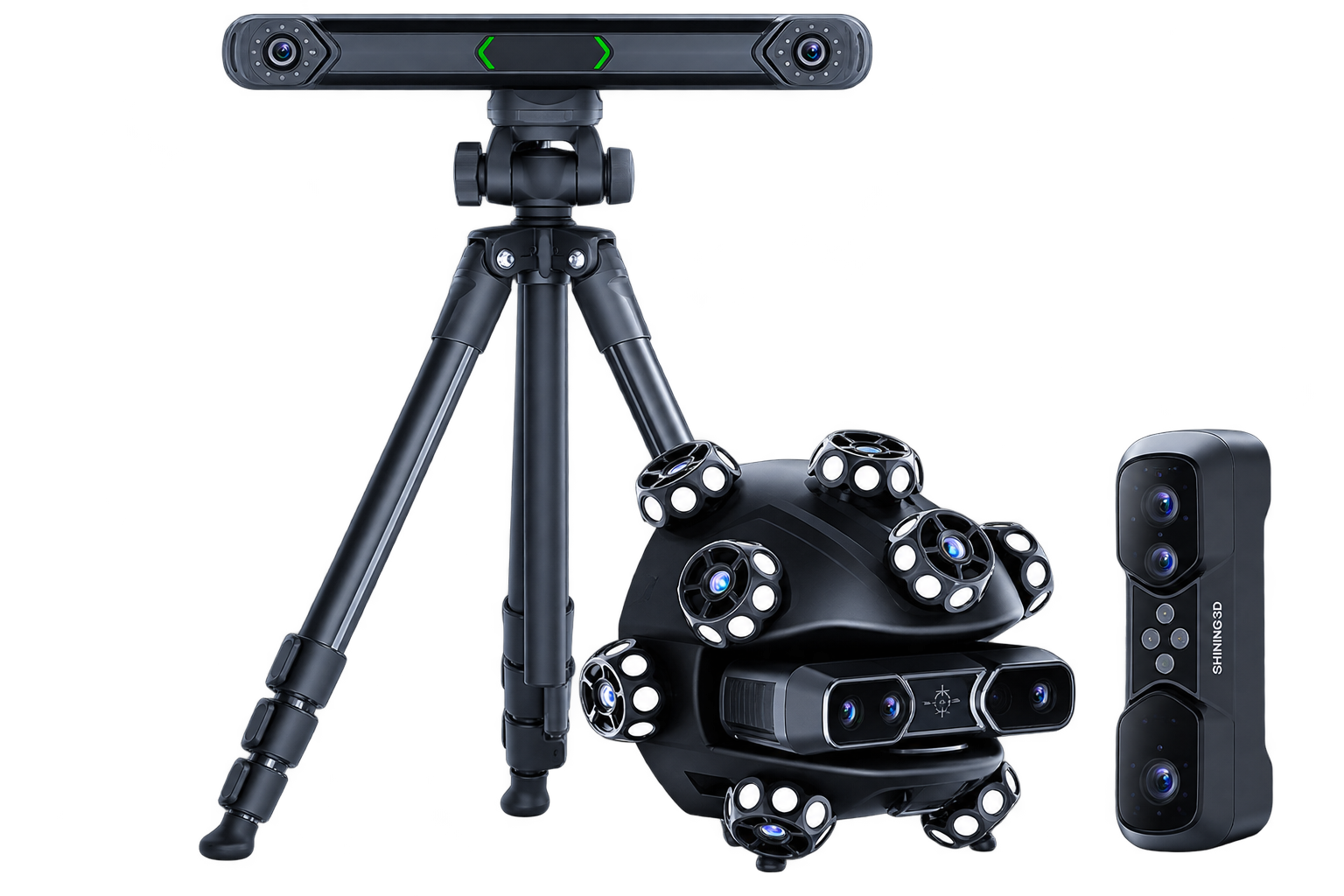
In our design office, we have expanded our range of services to include advanced 3D scanning and reverse engineering, dedicated to complex piping systems and engine room spaces, among other applications. We perform these services using the advanced SHINING 3D EinScan Trak wireless optical system.
The kit consists of a stationary optical tracker on a tripod and a handheld spherical scanning head equipped with power supply and Wi-Fi communication modules. The operating principle is based on the continuous tracking of the head’s position in space (within a working volume of up to 15 m³) by the tracker’s infrared cameras. As a result, scanning is performed dynamically and in real-time, completely eliminating the need to apply physical reference points (markers) to the objects being scanned.
The head emits blue laser lines that precisely capture the geometry of pipes, flanges, fittings, and structural elements. In tight recesses or hard-to-reach areas, the scanner can be disconnected from the tracking module and used as an independent handheld device. The data collected in this way allows for the rapid reconstruction of existing system geometries and the clash-free design of new pipeline routes in a CAD environment.
Key benefits for the shipbuilding industry and shipowners:
Unrivaled time savings, minimizing the downtime of ship systems from ongoing operation: The traditional method used previously involved a fitting team matching pipelines directly on-site, which was only feasible for simple structures. For tasks requiring more detailed planning, it was necessary to take multiple measurements, sketches, and hundreds of photographs to reconstruct the current situation on the ship in a CAD environment. This was prone to error and required a long stay of a qualified engineer on board the vessel. The use of 3D scanning enables the fast and accurate transfer of the existing situation to a computer, followed by the implementation of planned changes in an office environment. The system modification documentation prepared in this way allows pipeline sections to be manufactured and delivered on board the ship precisely when the decision to start renovation work is made. Minimizing the system downtime in this manner is particularly valuable for the most critical pipelines, which often determine the overall downtime of the entire vessel at the shipyard.
Perfect fit of prefabricated pipes: The point cloud and the 3D model from the scan guarantee that the newly designed pipeline sections fit without collisions, making the entire process more predictable in terms of both costs and execution time.
Scanning in tight engine room spaces: Thanks to the ability to detach the head and work in manual mode, we effortlessly collect data from densely built-up sections, hard-to-reach valves, and hull penetrations.
See our 3D projects: